
Opening names are useful labels, but they can create the illusion that every variation is a separate subject. In practice, many openings lead to familiar pawn structures, and those structures often matter more than the exact move order that produced them.
Learn the recurring shapes
An isolated queen’s pawn, hanging pawns, a Carlsbad structure, a closed center, or a kingside pawn chain each suggests typical plans. The pieces may arrive by different routes, but the strategic questions repeat. Where should the rooks go? Which pawn break matters? Which minor piece is strong or weak?
This approach makes opening study more durable. If an opponent deviates on move seven, you are less likely to feel lost because you still recognize the structure. You can make a move based on piece placement and pawn breaks rather than memory alone.
Use model games instead of long trees
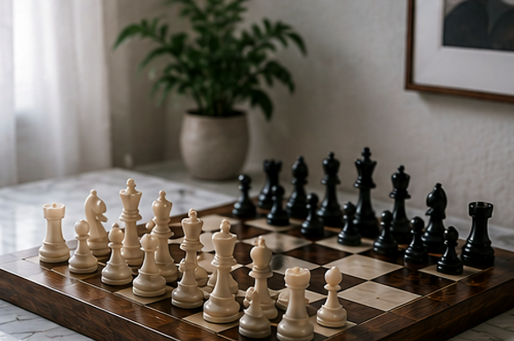
Choose a small number of complete games that show the structure clearly. Replay them without rushing through the opening. Pause when the position changes character and predict the plan. A collection of chess sets is not necessary for this; one clear board is enough, but physical replay can help when you want to notice how pieces are repositioned over several moves.
If you also play online chess, save games that reach your target structures and compare them with the model examples. Your own mistakes will reveal which plans you understand and which ones still feel vague.
A deeper way to train the same skill
It helps to think of the lesson as a chain: read the position, identify the most important imbalance, consider the opponent’s reply, and only then commit. The ideas expressed in “Learn the recurring shapes” and “Use model games instead of long trees” fit naturally into that chain. When one step is skipped, the final move may be strategically sensible but tactically mistimed.
The method is especially valuable after an inaccuracy. Players often respond to one mistake by forcing the next move, as if they need to repair the game immediately. A better response is to re-read the position from scratch. The old plan may no longer be relevant, and the most accurate continuation can be a quiet move that restores coordination or limits counterplay.
You can also build a small notebook around this topic. Each time the same type of position appears, record only one sentence: what you noticed too late. After ten examples, patterns usually emerge. Perhaps you ignore king safety, overvalue material, or calculate forcing moves before checking the opponent’s plan. That pattern tells you what to train next and makes future study much more specific.
Openings become easier to remember when they are connected to ideas. A pawn structure gives those ideas a shape that stays useful long after a memorized sequence is forgotten.